Request an assessment

 Circular Economy as a Service  ·  Philippines

Powering the circular economy.
Turning liabilities into resources.

Circular Economy as a Service (CEaaS) is a comprehensive, turnkey solution designed for forward-thinking organizations. We act as your dedicated sustainability partner, engineering a closed-loop system where your operational waste becomes a high-value resource. Instead of managing fragmented recycling efforts, your business plugs into an established, end-to-end circular supply chain.

  01  ·  The stream

Maximizing waste diversion means solving the hardest sorting challenges.

Of the four primary fractions in municipal solid waste, conventional infrastructure is built to process only one, leaving the rest for standard disposal. The Circular Economy Center represents the next step in waste processing. We focus entirely on the remaining three fractions, transforming historically hard-to-process materials into eco-building products and clean energy.

Recovered today

Clean recyclables

PET, aluminum, cardboard. Already has a market. Baled and forwarded to our recycler partners — the only fraction a conventional MRF pays for itself on.

→ Building material

Residual plastics & fines

Degraded packaging, mixed fines. No buyer, no market.  Moulded into structural blocks, pavers and aggregate.

→ Energy

Organic fraction

Food waste, market waste, agricultural runoff. Anaerobically digested into biogas and a pelletized soil conditioner.

→ Fuel & slag

Complex & hazardous

 Clinical waste and off‑spec commercial stock. Pyrolyzed to industrial fuel or vitrified to inert aggregate.

  02  ·  The facility

The Circular Economy Center

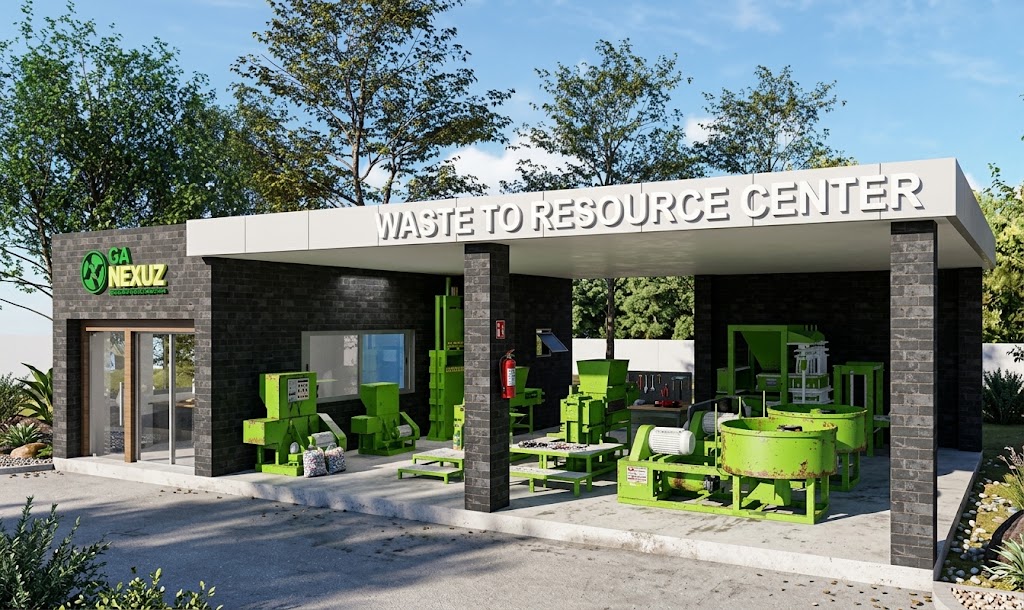
A conventional Materials Recovery Facility ends at the baler. A CEC keeps going: the fraction that has no buyer is extruded and moulded on site into construction materials, and what still can't be made into a block is converted into energy.

CECThe green path is the one a conventional MRF doesn't have. Everything above it — reception, sorting, baling — is standard practice; everything on and below it is what makes the facility circular rather than merely efficient. Modules are added per site after commissioning, so a municipality can start with blocks and add energy recovery when throughput justifies it.

  03  ·  Scaling a site

Five modules, added when the tonnage justifies them.

Each one takes a fraction the base facility would otherwise landfill and turns it into a saleable output. None is required on day one.

MOD 01

Biogas integration

in: organic MSW, market waste, agri runoff

Anaerobic digestion captures methane as a direct LPG substitute — piped to commercial kitchens, run through absorption chillers for off-grid cold storage, or burned in gensets for base-load power. The digestate becomes pelletised soil conditioner.

MOD 02

Pyrolysis plant

in: Plastic Waste

Controlled thermal degradation in an oxygen-free chamber breaks polymer bonds and condenses the vapour into synthetic diesel, industrial fuel oil and syngas. The syngas self-fuels the reactor; the oil runs the facility's own fleet and boilers.

MOD 03

Advanced gasification

in: mixed residual solids

Converts residual solid waste to syngas for gas engines, turbines or industrial boilers, with a sharp reduction in physical volume. The carbon-rich biochar byproduct goes to agriculture or straight back into the block line as aggregate.

MOD 04

Microwave sterilisation & shredding

in: clinical and biomedical waste

Extends a facility's licence to biomedical streams without incineration. Industrial shredding plus microwave sterilisation renders sharps, textiles and clinical materials sterile, unrecognisable and safe to process alongside municipal waste or use as RDF.

MOD 05

Plasma arc gasification

in: hazardous and brand-sensitive waste

For clients who need destruction rather than disposal. Plasma fields molecularly vaporise waste instead of burning it, guaranteeing irreversible elimination of off-spec branded stock. Non-organics melt to inert vitrified slag — a durable aggregate for paving.

MOD 06

Automated sorting matrix

in: throughput constraints

Replaces manual picking lines with optical sensors, near-infrared scanners and pneumatic ejectors. Raises feedstock purity for the extrusion line, lifts throughput, and removes workers from direct contact with raw municipal waste.

  04  ·  Where we are

Mapping Our Impact.

Scaling advanced resource recovery requires dedicated infrastructure. Our growing network of Circular Economy Centers represents the physical shift from standard waste disposal to material transformation.

SiteScopePartnerYearStatus
Maynilad Waste to Resource HubBio-Hub — wastewater sludge & biosolids Design, Build, Operate
Maynilad2024Operational
Victoria, LagunaMRF upgrade to eco-materials line Machinery supply & integration Dana Asia · LGU Victoria2024Operational
Sulu Sahaya Eco HiveMSW to blocks for provincial housing Machinery supply & integration Provincial Government of Sulu2024Operational
Plaridel, BulacanECOBLOCK structural block production Machinery supply & product line MENRO Plaridel2025Operational
Lubang Island, Occ. MindoroIsland MSW to local construction supply Machinery supply & integration Municipality of Lubang2025Operational
BARMM Waste to Resource CenterMulti-technology landfill alternative Feasibility, design, operate BARMM regional government2025In progress
Total Destruction & Medical Waste FacilityMicrowave shredding + plasma arc Deployment & commissioning ReClime · Saving Planet Earth2026In progress
Bulacan CECCircular Economy Complex — 300 TPD, with waste-to-green-energy Feasibility study, design, build & operate Confidential2026In progresspre-development
Batangas CECCircular Economy Complex — 150 TPD, with waste-to-green-energy Feasibility study, design, build & operate WasteCon Inc.2026In progresspre-development
Quezon City CECCity MSW to building materials Machinery supply Dana Asia2026In progress
Kota Ramitan Eco HiveMSW to building materials Machinery supply Kota Ramitan Cooperatives2026Operational
Butuan City CECCity MSW to building materials Machinery supply & O&M City Government of Butuan2026In progress

  05  ·  Partnership

Joint venture opportunity.

A Circular Economy Center needs four things: a waste stream, a site, capital, and somebody who can run it. We bring the technology and thirteen facilities' worth of operating experience. If you hold any one of the others, there is a venture here — and it does not have to be all four.

01  ·  OPERATE

Enter the waste-to-green-energy business

You want the sector
We bring the plant and the crews

Pyrolysis, biogas, gasification and plasma are not off-the-shelf purchases — they need a partner who has commissioned them and lives with the maintenance schedule. Come in on a facility rather than building a capability from nothing.

02  ·  FINANCE

Fund a project

You bring capital
We bring contracted offtake

Recovery infrastructure earns from two sides: tipping fees on what comes in, and sales of what goes out. Maynilad's five-year BioBrick term was signed before that plant was proven — that is the shape of the offtake a facility is underwritten against.

Or fund it as CSV or CSR, not for the return. The same facility puts livelihoods and green jobs into the community it collects from, captures carbon a landfill would have released, and produces audited diversion figures that go straight into your ESG reporting — shared value that can be counted, not sponsored.

03  ·  LAND

Idle land fit for a CEC

You bring the site
We bring everything on it

A site with road access for tipping vehicles, power and water, within reach of a real waste stream. Land that earns nothing today becomes the host of a facility — and the landowner takes a position in the venture rather than a ground rent.

04  ·  FACILITY

An idle waste facility

You bring a plant that stopped
We restart it

An MRF that never paid for itself, or a plant standing idle. Victoria, Lubang and Plaridel were all upgrades rather than new builds: the shed, the site and often the crew were already there — what was missing was the line that comes after the baler.

Every one of these starts the same way: a conversation about what you hold and what the waste stream near it actually looks like. No teaser, no data room — a call, then a feasibility study if it is worth one.

Talk to us Email directly

  06  ·  What comes out

The loop only closes if somebody buys the output.

Manufactured by Mason Bee, the group's production arm, from feedstock recovered at our own facilities. Specifications are the ones on the spec sheet — not a range.

ECOBLOCK — structural block

from: diverted municipal solid waste

L×W×H
400 × 100 × 200 mm
Weight
11 kg
Strength
700 PSI

Interlocking, so walls align without a string line. No plastering — the finish is the face. Less mortar per course, and roughly 10% off combined material and labour.

Eco Paver

from: diverted MSW + aggregate binder

L×W×H
200 × 100 × 50 mm
Weight
1.9 kg
Strength
3000 PSI

Plain finish for ultra-low water absorption in high-traffic industrial zones; rough and pervious finish for slip resistance and stormwater drainage where runoff pools.

OFENCE — modular panel & post

from: local waste composite, steel-reinforced

Panel
0.5 × 2 × 0.05 m
Post
0.16–0.24 m sq · 3 m
Install
30% faster

Rot-proof, termite-proof, weather-resistant. Stackable and demountable, so a perimeter can be relocated with the project rather than demolished with it.

Pyrolysis oil 

from: residual plastics 

Grade
Industrial diesel
Use
Boilers, kilns, marine
Form
liquid

Fuel for industrial boilers and kilns at below market diesel. 

07  ·  Two ways in

Which problem is yours?

For LGUs

Your landfill is filling and the alternative costs more every year.

  • Feasibility study first — waste characterisation, throughput modelling, and whether a CEC is actually the right answer for your volume.
  • Design, build and operate, so you are not left owning machinery you have no one to run.
  • Output feeds local infrastructure: barangay fencing, pavements, housing blocks — bought back at below imported cost.
  • Green jobs stay in the municipality; TESDA-certified training for the crew that runs it.

For enterprises

You have EPR obligations, an ESG report, and waste you currently pay to bury.

  • Waste audit and characterisation of your manufacturing and facility streams, with a costed diversion roadmap.
  • Verifiable plastic credits against EPR targets, funding recovery you can point to on a map.
  • Collection and Waste Diversion Certificates — auditable metrics for ESG reporting.
  • Secure destruction for off-spec and branded stock, where disposal isn't enough and elimination is the requirement.

08  ·  The group

Five companies, one chain of custody.

Most operators subcontract at least two of these steps. We don't, which is why a waste stream can be traced from the kerb to the block it ends up in.

01 · Collect

LoopX

Traceable transport of commercial and industrial waste. The frontline that feeds every facility.

02 · Operate

Nexuz

Circular Economy as a Service — the joint ventures and operating agreements themselves.

03 · Manufacture

Mason Bee

Turns recovered material into eco-building products for commercial, residential and agricultural work.

04 · Expand

GreenHive

Replicates proven facility models into new territories and markets.

05 · Retire

Circular ARO

Asset retirement and decommissioning — ARO financial modelling, salvage recovery, site restoration.

09  ·  Start here

Request a waste assessment

Every engagement starts the same way: we characterise what you actually generate before anyone proposes a facility. The assessment is a document you keep, whether or not you build with us.

Request received.

We'll confirm by email within 3 working days and propose a date for the site characterisation visit.

Already know what you need? Write to [email protected].